
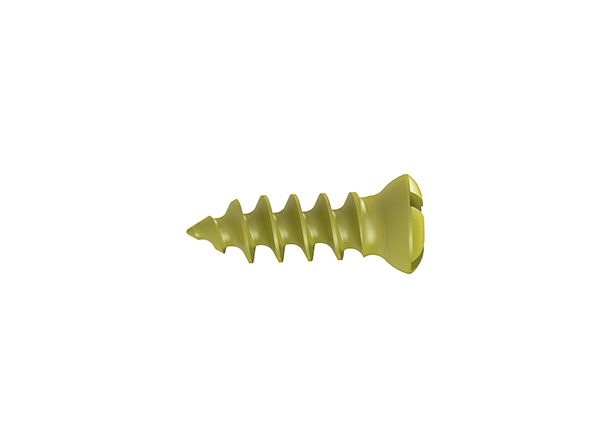
ANTERIOR CERVICAL SCREW

The SPINAL STABILIZATION AND FIXATION SYSTEM consists of many types of screws, dynamic and rigid rods, titanium/PEEK/carbon/Co-Cr-Mo rods with or without hexagonal heads, transverse connectors, cross connectors, connection connectors and many types of hooks. The screws used for fixation to the spine are monoaxial, polyaxial, hemispherical, cannulated, non-cannulated, low-profile head or spondylolisthesis screws. All these components come in two separate containers or boxes, in various sizes, configurations and implant and instrument variants. The implants are made of titanium, titanium alloys, PEEK (including barium sulfate) and Co-Cr-Mo because of their high biocompatibility and better visibility on MRI or CT scans.

To offer surgeons a wider choice of treatment better suited to patient pathology, the SPINAL STABILIZATION AND FIXATION SYSTEM includes three different interchangeable fixation options, all using the same range of pedicle screws. Because of their flexibility and high biocompatibility, some Spinal Stabilization and Fixation System rods are made of titanium alloys, PEEK (including barium sulfate), Co-Cr-Mo and carbon materials. In addition, the screws can be coated with hydroxyapatite (HA) to enhance the biological response.
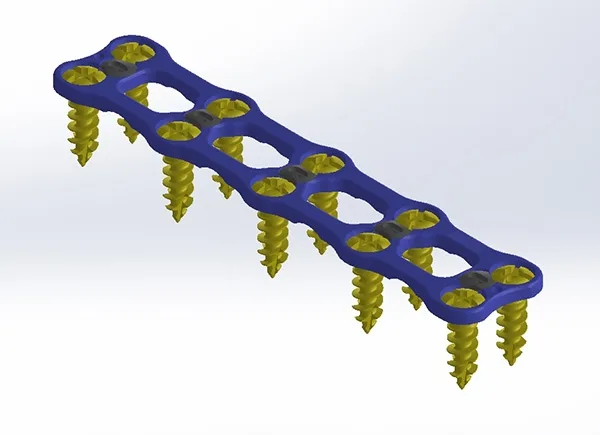
General Features of the Products

  • Controlled micro-movements
  • The conical head helps locate the trajectory of the prepared pedicle
  • Clinically meaningful angulation of ±10° to ±28°, depending on screw diameter and screw head angle, makes rod placement easy in both the M/L and C/C planes at the same time, regardless of pedicle trajectory
  • The compatible locking mechanism converts the screws from polyaxial to monoaxial, allowing true in-line compression and distraction of the construct
  • The ultra-thin footprint is facet-friendly and low-profile, while the higher rod center in the screw head allows more graft placement for solid lateral fusion
  • Enhances osteogenesis and bone fusion
  • Homogeneous stress distribution
  • Early rehabilitation without the need for a postoperative brace
  • Prevention of adjacent segment degeneration
  • Load sharing at the adjacent level
  • Intervertebral implants with a low-profile head and atraumatic shape
  • Operational flexibility and efficiency
  • Revisability
  • Adaptable to various surgical techniques
  • Efficient instruments
  • Fast assembly
  • Cannulated and non-cannulated screws
  • Self-tapping and non-self-tapping screws
  • Size identification by color code
  • Superior stability

Indications

The clamp system is a spinal fixation component that, combined with a compatible osteosynthesis system, provides the stability required for solid bone fusion and helps reduce spinal deformities and fractures.

The clamp system is indicated for the following applications:

  • Spinal trauma surgery as a component of spinal fusion;
  • Reconstructive spinal surgery as an implant combined with constructs intended to correct spinal deformities such as scoliosis, hyperkyphosis or spondylolisthesis;
  • Degenerative spinal surgery as a component of spinal fusion.

Anterior Cervical System